 Rey Gutierrez
What do the programmers you work with consider themselves these days?
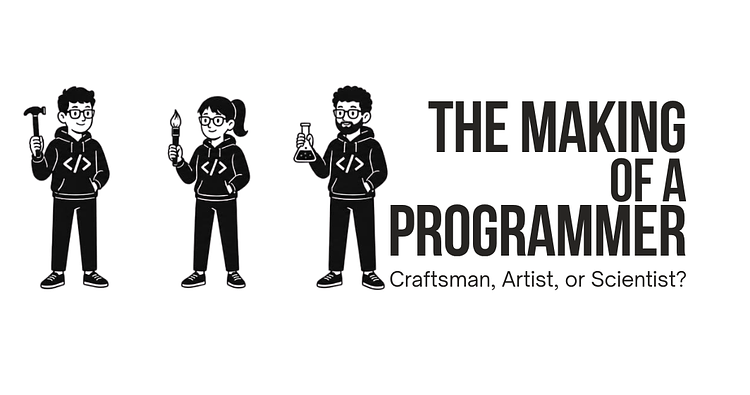
Programmers? Engineers? Craftsmen? Artists? Scientists?
I have been listening to the audiobook version of Coders at Work for the last few weeks. It is a series of interviews with 15 programming language designers and specialists, and at the center of the theme of the book lies the question:
“Do you consider yourself a programmer, engineer, craftsman, artist, or scientist?”
The answer varied from one notable person to another. However, there was a general consensus: most identified as craftsmen or engineers, with a few describing themselves as scientists.
This reflected the nature of applied computing at the time these interviews were conducted in 2008, when enterprise software was reaching a new level of scale, and the economic impact this had on the field of computing was, and still is, massive.
This is an eye-opening question worth asking again because the environment has changed since then. The biggest change in recent years has been the introduction of generated code via Large Language Models (LLMs), and the kind of work software developers do daily has largely changed.
There is now more emphasis on reviewing generated code.
There is less typing, more reading.
There is less working through the problem physically, more directing LLM output and coding agents.
This change reminded me of a similar dynamic I have seen in the past. A dynamic present in an artist, an architect, and a scientist.
Canova, Lloyd Wright, and Edison.
Canova was an Italian Neoclassical sculptor. He created shrines and figures from childhood, producing early masterpieces like Orpheus and Eurydice and Daedalus and Icarus.
Later, his success let him open his own studio, where he'd conceive and experiment to find a project's essence, leave most of the grunt work to assistants, then spend weeks or months himself on finishing touches, like hair, fabrics, and eye edges.
Frank Lloyd Wright was an architect known for his philosophy and how he applied it to his work. He insisted buildings conform to their environment, looking like a natural extension of it. He designed over a thousand structures in his career, with more than 500 realized.
Later in his career, he founded the Taliesin Fellowship, charging students tuition so they could learn under him while also serving as extra muscle and mental resources for his projects. Many of his most famous works, like the Guggenheim or Fallingwater, came about when he acted mostly as an overseer with tight control. Frank Lloyd Wright's buildings remained distinctly his despite him not doing most of the work, because his strong, rigid philosophy was enforced by his controlling nature.
Thomas Edison was an inventor and scientist who changed the world with over a thousand inventions, most famously those involving electricity and its use as a source of light. Early in his career, he was more of a tinkerer, working in solitude and quite literally getting his hands dirty taking things apart. While research laboratories weren't new, he expanded the idea by promoting his laboratories and his own name, and the concept of the "Research and Development laboratory" became fixed in the public mind.
Later in his career, his focus shifted to directing these laboratories and stamping his approval on the inventions that came out of them. He hired many skilled scientists, mathematicians, and machinists known as "Muckers," with whom he often had minimal interaction, though some projects still captivated him enough that he'd get back into the weeds even later in life.
These three figures show a changing relationship with their respective careers and work.
In their early years, they did much of the physical work themselves. Canova's chiseling, Wright's drafting, and Edison's tinkering were mind- and body-inclusive activities these skilled individuals carried out.
Yet later in life, it wasn’t their physical toil or movements that allowed them to make the greatest impact. Instead, it was the reference to their ideas and philosophies cultivated over a decades-long career.
Canova systematically created processes and used measuring instruments so he could trust those he employed more, since as long as they followed his system, they would roughly produce the outcome he wanted. As long as Canova was there at the beginning of the concept and at the end, the project remained a Canova, even though he did not do all the physical work himself.
Wright always had firm ideas and also a firm hand. His solitary vision meant there was always not only a direction, but almost an exact coordinate for where projects should end up. This, combined with his heavy involvement in reviewing the process, is what kept a Frank Lloyd Wright project a Frank Lloyd Wright project.
Later in his career, Edison exerted control through brand management. The Edison name itself became an idea, a mythos, a token of value. New inventions were measured against this token, and quality was controlled by it.
Each of these figures held an original title, and as technology changed, the meaning of their titles changed too.
We return to software development, and while we cannot insist that all software developers will become world-changing industry leaders, some parallels remain.
We have a pool of talent that has spent years manually toiling through bugs, refactoring, and reading code, and these ingrained skills live within them. They’ve developed ideas and philosophies about what constitutes meaningful, impactful work.
They now have access to LLMs that can produce a kind of unrefined portion of the grunt work. As a result, they can apply those ideas and philosophies at greater scale.
AI doesn't anticipate the natural progression of things; it just responds to the current prompt. It takes experience and forethought to build code that can be easily adjusted to meet new expectations or even just real-world usage.
Everything around us is managed or controlled by tech and, by extension, programming. Without systems that are built with care and consideration, the code that runs our lives becomes fragile and rigid. Built to 'work' for today's expectations isn't built to grow and evolve when new expectations inevitably arise.
Canova, the sculptor, turned into a studio lead.
Frank Lloyd Wright, the architect, turned into a schoolmaster.
Edison, the inventor, turned into a company figurehead.
The programmer turned into a ???